
SkySafe Findings Show Industry's Lack of Remote ID Readiness Makes Rule Enforcement Incredibly Complicated, Endangering Airspace Management and Safety
SAN DIEGO, CA / ACCESSWIRE / March 14, 2024 / SkySafe, a global leader in drone tracking data and intelligence, today released new research findings to determine which commercial drone manufacturers will be Remote ID compliant on Saturday, March 16. The Federal Aviation Administration (FAA)'s original deadline was in September 2023 for drones over 250 grams to broadcast identifying and positional information while in flight. That deadline was extended to March 16, 2024 to give manufacturers and operators more time to get ready. Drone operators found not to comply by the 16th could face fines and suspension or revocation of pilot certificates.
According to the FAA, more than 1M drones are registered in the United States today, with nearly 3.5 million total drones currently in use. The global commercial drone market will reach $58.4 billion in 2026. Growth at this pace necessitates the ability for authorities to differentiate authorized drones from those that may pose a threat. Remote ID is often likened to a digital license plate that provides a means for public safety and other authorized officials to identify the owner of a small UAS if flying in an unsafe manner or a restricted area.
SkySafe's research team sought to uncover the implementation details of standard Remote ID drones across seven manufacturers: DJI, Skydio, Autel, Parrot, SwellPro, EXO, and Yuneec. The research was initiated to determine how comprehensively manufacturers implemented the new Remote ID standards to make rule enforcement possible.
The scope of flawed Remote ID implementations discovered by SkySafe's research team in standard Remote ID drones flags the question of culpability. Who is at fault if a pilot is found to be operating a standard Remote ID drone that doesn't follow the required specifications? Who will hold manufacturers responsible for implementations that do not comply with the ASTM standard for Remote ID?
Significant inconsistencies in implementing the FAA-required specifications outlined in ASTM F3411 - 22a, "Standard Specification for Remote ID and Tracking," ?raise concerns and questions about accountability among many manufacturers SkySafe tested. While one of the seven followed the implementation perfectly, others ranged from confusing to potentially "disastrous," and in one case, claims of support are being made where no such support exists.
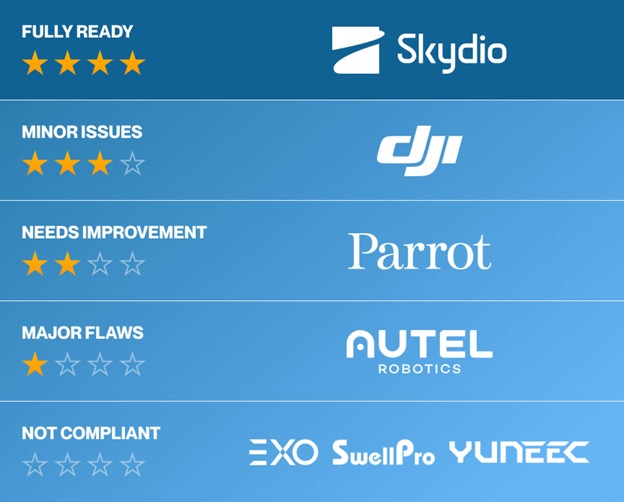
Only American drone company Skydio has properly implemented standard Remote ID technology in its current fleet models. Skydio's implementation of Remote ID earned a "Fully Ready" grade due to its accurate and robust implementation, which includes the use of compliant serial numbers and prohibiting its users from disabling Remote ID broadcasts in its mobile app.
DJI - received a "Minor Issues"
Parrot - received a "Needs Improvement"
Autel - received a "Major Flaws"
SwellPro - received a "Not Compliant" grade as there is no evidence of any Remote ID support in any of their drones as of February 2024. The SwellPro website claims support will be ready by March 2024 but includes no additional information on implementation.
SkySafe also examined EXO and Yuneec drones which received "Not Compliant". EXO is marketed as made by an American company but are rebranded Hubsan drones. One of EXO's standard Remote ID drones had no Remote ID (or FCC) compliance markings or serial numbers anywhere on the product packaging, exterior, or controller. No transmission of any Remote ID types were detected, either.
Read SkySafe's detailed findings for each of the seven manufacturers here
Vendors need to revisit their efforts around Remote ID implementation to rectify these shortcomings and ensure pilots can operate their drones safely and compliantly. Pilots can comply with the Remote ID requirement by upgrading older aircraft with a Remote ID module or operating a standard Remote ID drone. Embracing a culture of responsiveness around industry standards ensures the safeguarding of innovation and safety in the ever-evolving landscape of sUAS technology.
About SkySafe
SkySafe is a global leader in Drone Detection, Tracking, and Identification (DTI) as a Service (DaaS). SkySafe's drone intelligence platform turns data into action. Tested and validated by the FAA, SkySafe's technology is vetted and approved to ensure airspace safety, security, and world-class drone forensics capabilities. Its cloud-based SkySafe One platform, the most comprehensive on the market, provides real-time and historical UAS identification, activity tracking, and telemetry data for teams responsible for protecting cities, infrastructure, the public, and campuses. Teams using SkySafe for localized airspace intelligence and management get alerts to drones within their area to manage potential threats, approve authorized flights, and better understand the entire space around their assigned protective envelope.
Founded in 2015 and based in San Diego, California, SkySafe was started by and employs recognized experts in drone threat analysis. SkySafe's technology is made in the U.S.A. and distributed globally. For more information, visit www.skysafe.ioor follow us on LinkedIn or X@SkySafe
Media Contacts:
Escalate PR for SkySafe
Skysafe@escalatepr.com
SOURCE: SkySafe
View the original press release on accesswire.com
